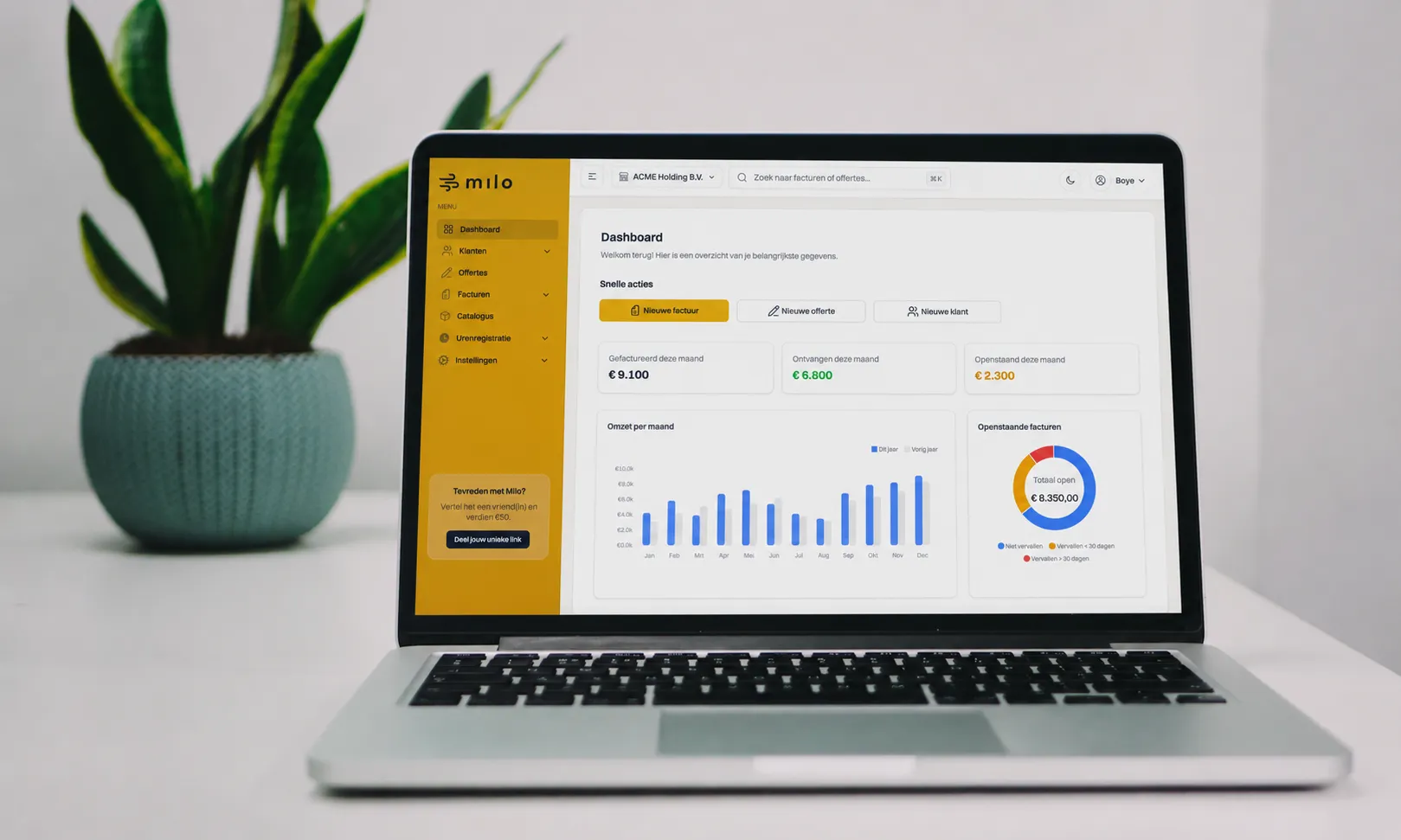
What is Milo?
Milo is a platform that lets freelancers and small businesses create invoices and quotes quickly and professionally. Not a heavy accounting suite full of features you'll never use, but a simple tool that grows with your business.
- Simple: no finance background required
- Professional: invoices and quotes that make your business look serious
- Offline-first: works without signal and syncs automatically
- Smart: AI and voice commands that genuinely save time
- Future-proof: UBL e-invoicing (Peppol-ready) for the upcoming requirements
Milo is a SaaS product we develop and co-build together with a partner. Below we explain how we approach it and what we take from it into our client work.
The problem
For many freelancers and small businesses, administration isn't a core competency but it is an ongoing obligation. Existing invoicing platforms tend to be either too basic (a PDF generator, that's it) or too heavy (full accounting suites with features you'll never use). On top of that, many of those platforms only work online, while entrepreneurs often need to write a quote or invoice in a workshop, on location, or on a train.
We saw space for a platform that:
- stays simple for people without a finance background;
- looks professional so it strengthens the brand;
- works offline without you having to think about it;
- uses AI where it actually saves time, no gimmicks.
That's how Milo came about: a SaaS product for invoicing and quoting that we co-develop and co-build together with a partner.
The approach
We build Milo as a product, not as a project. Short iterations, releases via semantic-release, dedicated monitoring, and a product roadmap shaped in close collaboration with our partner based on user feedback. Because we're co-owners of the result, we hold ourselves to the same discipline we recommend to clients.
Frontend: offline-first PWA
The Milo app is a Progressive Web App built on Vue 3, Vite, and Pinia. Offline-first isn't an afterthought but an architectural choice: a service worker with intelligent caching strategies, an offline queue for forms, and automatic background sync as soon as connectivity returns.
In practice: an entrepreneur can create an invoice or quote in a warehouse without signal, and once back online everything is cleanly written to the API without them having to do anything. No lost work, no "please retry" error messages.
The rest of the frontend is written entirely in TypeScript, with persistent state management, multilingual support, in-app viewing of invoices and quotes, digital signing of quotes, and clear insight into revenue, outstanding invoices, and payment trends.
Backend: Laravel 12
The API runs on Laravel 12 with secure authentication (including 2FA), robust queue processing for mail, PDF generation, and sync jobs, and invoices that are generated both as a polished PDF and in valid UBL format (Peppol-ready). In production, we actively monitor for errors.
CI/CD and release discipline
We release predictably through automated pipelines with semantic-release based on commit conventions, and work with consistent, containerized development environments.
Notable features
AI and voice commands
Milo includes AI functionality that genuinely saves time rather than being a feature-stuffer. Think voice commands to quickly create an invoice ("New invoice for client X, 4 hours of consultancy at 95 euros") or smart suggestions based on previous quotes.
UBL / Peppol-ready
Invoices are generated not only as PDF but also in UBL format. That makes Milo ready for the European e-invoicing requirement being rolled out in phases. Via Peppol integration, invoices can be delivered electronically directly to large business customers or government buyers.
Multi-device and multi-platform
Because Milo is a PWA, users can install the app on desktop, iPad, or phone without us having to maintain separate native apps. One codebase, all platforms, with native-like features (install, push notifications, offline).
What we take from this into client work
Milo isn't a one-off project but a living lab for the patterns we also apply in client work:
- Offline-first and PWA as an alternative to expensive native apps when appropriate
- Laravel + Vue 3 as a productive full-stack combo for custom SaaS
- UBL / e-invoicing as a concrete answer to European requirements
- Strict CI/CD with semantic-release for predictable releases
- AI integration where it saves time rather than as a marketing layer
Problems we solve for Milo, we often also solve for clients. And the other way around — patterns we develop with clients find their way into Milo.
In short
Milo is an offline-first PWA on Vue 3 with a Laravel 12 API, UBL/Peppol e-invoicing, and AI assistance. As a product, we deliberately keep the deeper architectural choices in-house — we're happy to share the underlying patterns in a personal conversation.
More about Milo
Working on something similar?
Building your own SaaS product, or considering a PWA architecture for an existing application? We have the patterns on the shelf — literally inside Milo. Schedule a no-obligation conversation via info@codemill.dev or the contact form.